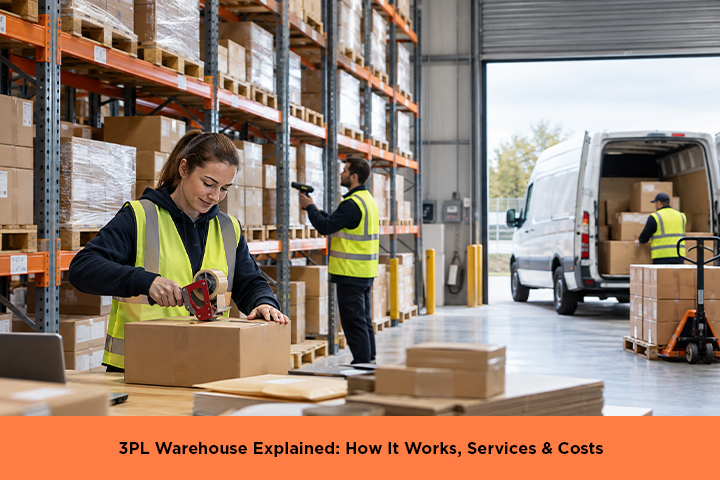

A third party logistics (3PL) warehouse assists businesses to store, pack and deliver customer orders. It controls stock and shipping, without businesses having to maintain their own warehouses. This not only saves time but also cuts down on workload and helps in business growth.
In the UK, numerous companies are turning to 3PL warehousing to deal with the surge in eCommerce orders. These services can go a long way in meeting the customer needs without requiring additional personnel in the warehouse. But how does a 3PL warehouse work? What services does it offer and what is the price of the services? This guide will tell you all you need to know about 3PL warehouses.
Explore our essential guide to 3PL to discover how third-party logistics can simplify your business operations and improve delivery efficiency.
A 3PL warehouse is simply a storage and order fulfilment facility that is managed by an external provider. It provides logistics services for companies selling products. They may be responsible for taking in stock, holding items, packing orders and arranging deliveries.
These are handled by a 3PL provider. Instead you are in focus on sales, marketing, and customer service.
For instance, a UK online clothing company could get hundreds of orders throughout the day. A 3PL warehouse can keep their clothes and send them out as per order. This eliminates the need to have a dedicated warehouse.
3PL fulfilment warehouse can serve online stores, wholesalers and retail brands. Its services can also expand as a business grows.
A 3PL warehouse has a clearly defined procedure from stock receipt to final delivery. These are the five key stages most providers deal with.
First, products are shipped from your supplier to your 3PL warehouse. Goods are counted by the warehouse staff and looked for any apparent damage. They document the received stock in their stock system.
Staff then put products in appropriate storage areas. These can be shelving, bins, racks or pallets. A warehouse management system is used to control the stock level and its location.
This technology helps to maintain accurate stock records and minimise picking errors. Online dashboards are a useful tool for businesses to see inventory updates.
The Warehouse receives details from customers when they place an order. Incorporated software will instantly move orders into your online store. Staff then arrange for the orders to be fulfilled.
The ordered products are retrieved from the storage area by the warehouse personnel. They inspect and ensure items are properly packed for delivery. The team attaches shipping labels and any necessary documents.
Packaging should safeguard the product and regulate the size of the package. This can also aid companies to handle shipping expenses.
The warehouse gave packed orders to the appropriate delivery companies. Carriers may be UK based such as Royal Mail, DPD, DHL etc. Customers are then sent their orders via the delivery service of choice.
The warehouse can handle returns if customers return products. Items returned are checked by staff and the condition noted. Appropriate products can be restocked for re-sale.
3PL warehousing services are about more than just storing products and dispatching orders. Providers provide various services according to the needs of the business.
A 3PL provider monitors inventory and product flow. Other systems will also provide low stock alerts and inventory reports. This assists businesses in their planning for replenishing stock and preventing unplanned stock shortages.
Order fulfillment involves picking, packing, labelling and shipping customers’ orders. These are performed by a 3rd party fulfilment house for your enterprise.
This service is best suited for online retailers that have a rising number of orders. It can also be used to manage seasonal demand.
Kitting is a process of packaging multiple products together as a single shipment. For instance, a provider can sell skin care items in packages of gifts. Some warehouses can also put together items or make subscription boxes.
There are some 3PLs that deal with large portions for retail stores and shops. They might be responsible for pallet preparation, product labelling and delivery requirements. These services support companies to provide several retail stores.
Cross-docking eliminates the need to store and retrieve goods from the rear warehouse. There is little storage time involved in this process. It can decrease storage space and accelerate distribution.
Some providers arrange international deliveries, and prepare shipping documents. They also can assist with documents for customs and arrange appropriate carriers. The import duties, taxes and customs still vary from shipment to shipment.
A 3PL return warehouse is used for businesses to process the goods that are returned. Staff check products, log returns and identify reusable products. Some exchanges and returns reporting is also supported.
Tell us your requirements, and let our experts build a Reliable solution around your business.
Tell us about your products, orders and delivery needs.
We plan the right logistics services for your business.
Your logistics will be managed with care and efficiency.
3rd party warehouse management is the process of delegating the management of the warehouse to a third party logistics service provider. The provider carries out agreed activities with its staff, systems and facilities.
These activities can be organised with the assistance of a warehouse management system (WMS). It keeps track of the stock’s position, incoming goods and outgoing orders. Some also integrate with ecommerce and inventory systems.
Each provider will have different reports and software integrations to choose from; businesses should ensure they are included in their services. Stock clearance assists in the avoidance of mistakes and visibility of orders.
3rd party warehouse costs vary based on the size of the storage space, order volumes and service requirements. Providers can also impose charges for receiving, storage, packing and delivery.
Different providers and service contracts offer different prices in the UK. The above figures are indicative only, and do not reflect verified UK averages.
| Cost Type | Example Pricing | What It Covers |
| Setup fees | £100–£1,000+ | Account setup and software integration |
| Receiving fees | £20–£40 per hour | Unloading and checking incoming goods |
| Pallet storage | £15–£30 per month | Storing one pallet of products |
| Shelf or bin storage | £1–£5 per month | Storing smaller products |
| Pick and pack | £2–£4 per order | Picking and packing the first item |
| Extra items | £0.50–£1 per item | Picking additional items |
| Shipping | Varies | Delivering parcels to customers |
Actual charges are dependent on the provider, location, and contract. Prices vary by provider and/or minimum monthly requirement.
There are multiple factors that will affect the overall cost of the 3PL warehouse.
Whenever you choose a provider, make sure to get a proper quote from them. Pay attention to minimum rates, surcharges, and contract conditions.
3PL warehouse can help businesses manage their logistics processes more efficiently.
Reduce operating costs: You do not need to have your own warehouse and workforce.
More time: More time can be spent on the development of your business.
Flexible capacity: Many providers can accommodate changing volumes of orders.
Faster dispatch: Existing warehouse processes can help orders move out quickly.
Better stock control: Warehouse systems ensure better inventory record and stock visibility.
Delivery options: Providers may offer a choice of carriers and delivery services.
However, not all providers offer equal levels of service. Prior to signing any contracts, it is important to check whether the service is the right one, whether it will offer the required service, communicate effectively and give the correct pricing.
Choosing the best 3PL warehouse is dependent on your products and business needs. Make sure to do a comparative analysis before you choose the provider.
Take the following factors into account:
The 3PL warehouse finder will help you find suitable providers. You have to analyze different services, locations, and prices prior to requesting quotes.
In case you need a certain 3PL warehouse solution, make sure to check the experience of the provider in working with similar products. For instance, if your business needs extra packing service due to fragility of items.
Certain providers may specialize in some products or industries. For instance, when a user searches for named providers, he or she will see the service of Wavepoint 3PL warehouse. It is important to consider a service, location and the rightness of the provider.
3PL warehouse can be a good choice for those who need extra storage or fulfillments. It is particularly helpful if you find it hard to manage orders internally.
Small businesses can hire 3pl logistics services without having to invest in their own warehouses. Larger businesses can use 3PL companies to manage the busy season.
However, it means that you will need to rely on another company in managing logistics. Prior to deciding whether to use 3PL warehouse or not, you have to compare services, prices, technology, and contracts.
Third-party warehouse is responsible for storage, order fulfillment, shipping and returns of other companies. It assists the UK retailers to streamline logistics without operating their own warehouse facility.
The cost is dependent on the level of stock, volumes of orders, handling requirements and delivery requirements. A third-party warehouse is responsible for storage, order fulfillment, shipping, and returns for other companies.
Prior to choosing a provider, make sure to request a proper quote and check all the costs. The right 3PL partner can help with fulfillment and push your business to success.
A 3PL provider manages logistics tasks, such as warehousing and order fulfilment. Typically, a 4PL provider will manage the broader supply chain. It can handle multiple logistics vendors for a business.
Absolutely, 3PL warehouse services can be utilized by a small business. There are plenty of providers that offer support to startups and expanding online stores. Others provide flexible plans according to the order volume and storage requirements. This allows for smaller businesses to outsource their logistics without having to construct logistics facilities.
There are many 3PL warehouses that integrate with platforms such as Shopify and Amazon. These links streamline order transfers and automate stock updates. But some providers offer more integrations than others. When selecting a service, be sure to check for compatibility.
Typically, the business is the owner of the stored products. The 3PL provider will store and manage them according to a mutual contract. Ownership is normally transferred as a result of a separate transaction. Specifically, businesses are advised to review their contracts to identify the content.
The provider investigates and looks into the incident and checks in the provider's warehouse records. Responsibility is based upon the contract and the situation. Some contracts involve liability limits and conditions on compensation. Prior to signing, it is important for businesses to examine insurance coverage and the claims process.
Yes, it is possible to change 3PL providers for a business. But, it relies on the contract that it currently has. Businesses may have to make stock transfers and software connections. Look up notice periods, exit fees and transfer fees in advance.
The optimal stock level is based on sales, demand and supplier lead time. Firstly, businesses should check their sales records and the seasonal trends. If too much stock is sent it can lead to higher storage costs. If not enough is shipped it can lead to stockouts and late orders.
"*" indicates required fields