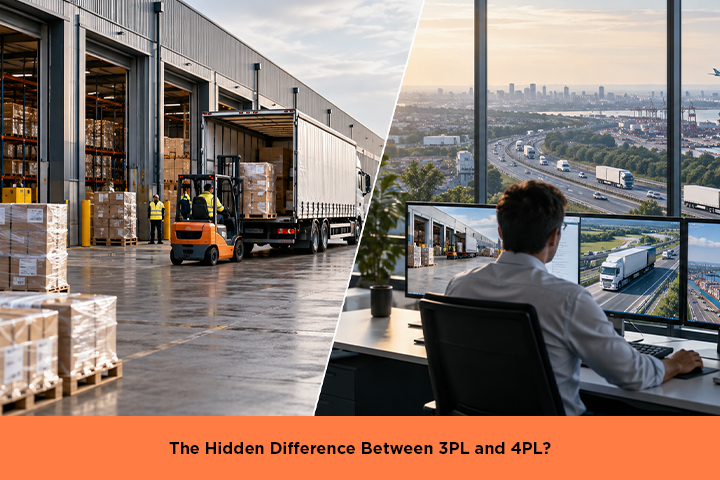

Opting for an appropriate logistics model will allow your business to grow without unnecessary expenses. Nevertheless, stock keeping, warehousing, delivery and returns could be rather complicated to manage. Here come 3PL, 4PL and 5PL models. They use your supply chain differently.
3PL (Third-Party Logistics) is responsible for the operational side of logistics: stock keeping and delivery. 4PL (Fourth-Party Logistics) manages your entire supply chain and coordinates multiple logistics providers. 5PL (Fifth-Party Logistics) concentrates on the network scale, technology and improvement of the supply chain. The understanding of each model will help you make the right choice.
3PL is the process of outsourcing logistics activities to another company. It takes responsibility for some or all of your fulfillment activities.
A 3PL could have its own warehouses, vehicles or distribution centres. It may also share facilities to provide service to a number of businesses.
These are all key business activities that a 3PL usually handles:
If you are a startup, an online retailer or growing company requiring assistance in the fulfillment, then 3PL will suit you perfectly. It allows you to concentrate on developing your business. It allows logistics facilities to be accessed while requiring no significant investment.
Warehouse systems and delivery networks are also available and ready for use by businesses. Typically, they still have to take care of their larger supply chain strategy. For further information, read the 3PL complete guide to know it in depth.
A fourth party logistics services offer a wider approach to the management of a business’s supply chain. It manages several logistics partners, rather than just focusing on fulfillment.
A 4PL can oversee warehouses, carriers, suppliers and various 3PL providers. It will look to enhance efficiency throughout the supply chain.
Not all 4PL providers have warehouses or delivery vehicles. Rather, they control partners from the outside and coordinate their activities through technology.
The 4PL is usually responsible for managing these strategic functions:
A 4PL is ideal for larger business entities that have business models with complex or global supply chains. Can streamline logistical management between various warehouses, suppliers and transport partners.
For businesses, there’s also a single place to keep track of logistics decisions. This is a way for leaders to concentrate on growth rather than on coordination on a daily basis.
5PL concentrates on the management and improvement of the wider network of the supply chain. 5PL usually involves advanced technology, automation and analytics. 5PL can coordinate multiple logistics providers within the company and the supply chain. It is designed to enhance efficiency, lower costs, and handle extensive logistics requirements.
For instance, an online marketplace can partner with a number of fulfilment providers. A 5PL can support them in the coordination of their networks and in delivery planning.
But 5PL is not a uniform service among all logistics companies. However, it’s specific services vary based on the company and its business model.
For large eCommerce businesses with a lot of orders, a 5PL might be an appropriate choice. It can also enable companies to function in multiple markets and across multiple fulfillment networks.
This model is suitable for businesses that want to use a lot of data and automation to plan. Smaller companies may not require this much support.
Tell us your requirements, and let our experts build a Reliable solution around your business.
Tell us about your products, orders and delivery needs.
We plan the right logistics services for your business.
Your logistics will be managed with care and efficiency.
The primary difference comes in the amount of responsibility each provider assumes. A 3PL is responsible for logistics functions, and a 4PL is responsible for managing the broader supply chain. A 5PL is more interested in bigger networks and technology optimisation.
| Comparison | 3PL | 4PL | 5PL |
| Main role | Handles logistics tasks | Manages the supply chain | Optimises wider logistics networks |
| Scope | Specific logistics activities | End-to-end supply chain coordination | Multiple networks and supply chains |
| Daily operations | Often performs fulfilment | Coordinates logistics providers | Uses technology to optimise networks |
| Physical assets | May own warehouses or vehicles | Usually coordinates external providers | Often relies on logistics partners |
| Technology | Tracks stock and shipments | Connects partners and systems | Often uses advanced analytics and automation |
| Best suited for | Small and growing businesses | Complex supply chains | Large-scale, technology-driven logistics |
Service agreements are more important than labels as these models may overlap.
Each model has its own merits. This depends on what your business requires, the budget and how complex your supply chain is. Given below are the pros and cons in brief, you can also know comprehensive 3PL (Third-Party Logistics) advantages and disadvantages.
| Feature | 3PL | 4PL | 5PL |
| Cost | Reduces the need for owned facilities | Identifies savings across multiple providers | Seeks savings across wider logistics networks |
| Speed | Uses established fulfilment processes | Improves coordination between partners | Uses automation to improve network efficiency |
| Control | Offers agreed control over fulfilment tasks | Supports central supply chain oversight | Focuses on network-wide planning |
| Visibility | Tracks stock and orders | Combines data from different partners | Analyses wider network performance |
| Scalability | Adds fulfilment capacity as demand grows | Coordinates expansion across multiple locations | Supports growth across large logistics networks |
| Challenge | 3PL | 4PL | 5PL |
| Control | Less direct control over daily fulfilment | Greater reliance on the management partner | Greater dependence on network coordination |
| Flexibility | Changing providers can disrupt operations | Implementation can take considerable time | Complex technology can make changes difficult |
| Cost | Extra storage or seasonal charges may apply | Management fees may be higher | Advanced systems can require significant investment |
| Complexity | Multiple providers create extra administration | Partner coordination requires strong systems | Large networks demand extensive data integration |
The number of actual costs and responsibilities will be determined by contracts, services and business requirements.
There are two different types of logistics management in these two models.
The 3PL provides tracking updates and stock information to the company. This enables customers to track their orders and businesses to keep track of fulfilment.
A 4PL helps diagnose and improve the performance of the supply chain by coordinating multiple aspects of the supply chain. A 5PL does the same but on the network-wide scale involving the advanced technology.
It depends on your needs and plans for the future.
A 3PL is a good first step. 3PL provides you with warehousing, packing and delivery without the necessity of having your own warehouse.
Fast-growing eCommerce companies: 3PL will be able to handle more orders. Thus, you will be able to focus on sales. However, when working with many providers gets difficult, it is time to opt for 4PL.
Large businesses with complex supply chains: 4PL will be able to manage many warehouses, suppliers and delivery providers. It gives you a broader perspective and improves the supply chain.
Businesses with large logistics networks: 5PL may be the right choice for you. However, pay attention to its technology, costs and services.
When logistics management becomes a real problem for your team, it’s time to consider a switch. The most ubiquitous trouble signs are increased administration, lack of connectivity and restricted supply chain visibility.
A 4PL is able to offer greater coordination between different providers. But weigh the benefits against the added expense of managing.
It is not a rule that a business needs to go with 3PL or 4PL. These models may be integrated into a single supply chain.
The 4PL coordinates the entire logistics strategy and provides the required partners. On the other hand, 3PL service providers provide you with warehousing, packing and physical delivery.
Technology is used to link their enterprise, transport and warehouse. Common data provide better stock visibility, delivery planning and performance reporting.
This solution allows businesses to oversee logistics centrally, but doesn’t supplant actual logistics providers.
The knowledge of 3PL, 4PL and 5PL enables you to make better logistics decisions. Different models have different levels of supply chain management.
A 3PL can deal with handling the practical tasks of fulfilment and it is appropriate for many expanding companies. A 4PL is the one who manages several providers and helps in complex supply chains. A 5PL specializes in bigger networks, technology and large scale optimisation.
If your business needs support with day-to-day logistics, Transit Fleet’s 3PL services can help manage transport, warehousing and deliveries while you focus on growth.
Consider the order volumes, operational problems, budget and development.
A 3PL covers logistics aspects like warehousing and order fulfilment, while a 4PL oversees the broader supply chain and works with multiple logistics providers.
A 4PL oversees an individual business's supply chain and logistics partners. A 5PL is more concerned with optimizing larger networks, typically using technology and automation.
When businesses require simple fulfilment services, they typically end up paying a lower price to a 3PL. A 4PL could be more expensive due to its broader management. But the real costs vary according to the services needed.
Yes, but if your logistical needs are simple, perhaps one can't help you out. A small business with multiple providers may benefit from more wide-spread coordination.
Most 4PLs don't own assets, they just manage other outsourced logistics partners. But there are some providers who also provide their own logistics as well.
A 5PL can streamline a network's efficiency using automation and data analysis. 5PL mainly facilitates large-scale operations and minimise logistics costs.
Yes, a 4PL can interface multiple 3PLs, enabling companies to coordinate their warehouses, deliveries and performance at a single platform.
For smaller online retailers requiring storage and fulfilment, a 3PL may be the best option. As networks grow more complex in larger businesses, a 4PL or 5PL may be a possibility.
"*" indicates required fields